China Top Dog Harness And Leash Set Manufacturers?

Time:2026-09-25 Author:Isabella
0%

Choosing among China’s top Dog Harness And Leash Set manufacturers requires more than comparing prices or attractive product photos. Reliable sourcing begins with construction details. Buyers should examine webbing strength, breathable mesh, reinforced stitching, buckle quality, leash clips, and size consistency. A neat sample can still hide weak stress points.

Lindsey A. Wolko, founder of the Center for Pet Safety, has stated, “Not all harnesses are created equal.” That warning remains practical for importers, retailers, and pet brands. A dependable manufacturer should explain its materials, testing process, quality controls, and customization limits clearly. Factory experience matters, but transparent evidence matters more. Ask for inspection records, production samples, and packaging details before placing a large order.

Small details reveal manufacturing discipline. Check whether the chest panel shifts during movement. Pull the leash clip by hand. Inspect every seam near the D-ring. These simple checks can expose inconsistent workmanship. A manufacturer may offer excellent OEM support, fast communication, and competitive pricing, yet still need improvement in sizing or final inspection. That is worth admitting.

This guide explores China’s leading Dog Harness And Leash Set manufacturers through product quality, production capability, certifications, customization options, and service reliability. It also considers practical concerns that catalogs often overlook, including comfort for short-nosed dogs, adjustment range, reflective visibility, and long-term wear. The best supplier is not always the largest factory. Sometimes, it is the partner willing to discuss weaknesses, correct a sample, and document each improvement.
China Top Dog Harness And Leash Set Manufacturers?

Types of Dog Harness and Leash Sets Made in China

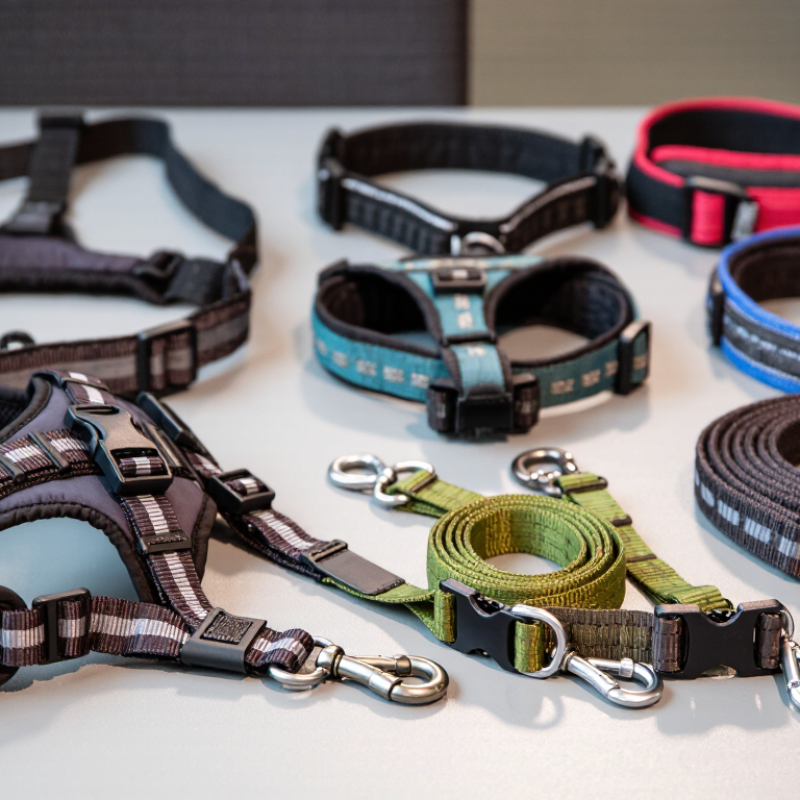
China-made dog harness and leash sets commonly include step-in, vest, and Y-shaped designs. Step-in styles suit dogs that dislike equipment passing over their heads. Vest harnesses spread pressure across the chest, while Y-shaped models leave more shoulder movement. Some sets add a front attachment point to discourage pulling. That feature is not a substitute for training.

Materials vary. Lightweight mesh suits warm walks, but rough edges can rub under a dog’s front legs. Woven nylon is common for everyday sets; padded webbing and rope styles offer a softer or more textured grip. Matching leashes may be fixed-length, adjustable, or fitted with a short traffic handle for close control. Reflective stitching helps in dim light. Check buckle strength, seam consistency, and clip movement by hand before use. Small defects matter.

Demand offers context, not proof of product quality. The American Pet Products Association’s 2025 State of the Industry report estimates that 94 million U.S. households own pets; this is a broad ownership figure, not harness-specific sales data. For buyers comparing Chinese-made sets, request size measurements, material details, and test records for the actual production run. A neat sample can still hide uneven stitching. That deserves a second look.

Key Factors for Evaluating Chinese Manufacturers

China Top Dog Harness And Leash Set Manufacturers?

Evaluating Chinese manufacturers requires more than comparing catalog prices. APPA’s 2023–2024 National Pet Owners Survey reported that 66% of U.S. households owned a pet. Demand is substantial, but quality expectations are higher. Inspect webbing density, buckle strength, stitching patterns, and edge finishing on physical samples. A polished sample can still hide weak production control.

Ask for documented material specifications, factory audit records, and batch-level inspection reports. ISO 9001 certification can indicate a quality management system, but it does not guarantee every harness is reliable. Request test evidence for tensile strength, colorfastness, abrasion resistance, and metal corrosion. The global pet accessories market was valued at approximately US$6.1 billion in 2022, according to Grand View Research. Competition is intense. Some quotations look attractive until packaging, testing, defects, and replacement costs appear.

Tips: Compare at least three suppliers using the same specification sheet. Check whether the factory accepts independent inspections. Test several sizes, not just one. Measure pull strength with realistic loads and repeated movement. I have found that weak adjustment points often appear after washing, not during the first fitting. This is easy to miss. Also verify production capacity during peak seasons, because promised lead times may become less dependable. Supplier evaluation should include communication accuracy, corrective-action speed, and traceable records, not only low prices.

China Dog Harness and Leash Set Manufacturers: Key Evaluation Factors

Suggested evaluation weights for comparing suppliers. These are a practical scoring framework, not verified market statistics.

Prioritize product safety, material compliance, and quality control. Verify test reports, applicable regulatory documentation, inspection procedures, and traceability with each supplier before placing an order.

Leading Manufacturing Regions and Production Capabilities

China’s dog harness and leash production is concentrated in several coastal manufacturing regions. Guangdong has a strong base for cut-and-sew work, webbing, buckles, and packaging. Zhejiang and Jiangsu offer established textile and accessory supply networks. Shandong also supports textile processing and hardware production. Capabilities vary by factory, not just by province.

Many manufacturers can combine polyester or nylon webbing, padded mesh, reflective strips, and metal or plastic fittings. Some provide pattern development, sample making, custom sizing, and private-label packaging. A capable supplier should explain how it checks stitch strength, buckle fit, color consistency, and leash attachment points. Ask to see the production steps and inspection records. A polished sample helps, but it does not prove every production batch will match. No region is perfect; supplier maps can look cleaner than factory reality.

Tips: Request samples in your intended materials and sizes. Check seams by hand, test adjusters, and inspect hardware for rough edges. Ask how defects are recorded and what happens when measurements vary. Keep specifications in writing. Small details matter. The first sample may still need revision.

China Top Dog Harness And Leash Set Manufacturers? - Leading Manufacturing Regions and Production Capabilities

Regional profiles below are based on broader, established manufacturing strengths. They are qualitative sourcing guidance, not statistics on dog-harness production; capabilities vary by factory and should be confirmed directly.

Manufacturing region Relevant industrial strengths Potential harness and leash capabilities Common materials and processes to verify Useful sourcing considerations
Zhejiang
Including Yiwu and Ningbo
Yiwu is widely known for small commodities and wholesale trade; Ningbo is a major port and manufacturing city. A potential sourcing area for coordinated accessory sets, product assortment, packaging, and export-oriented order handling. Ask whether the supplier handles webbing, sewn panels, buckles, metal fittings, reflective trims, and set assembly in-house or through subcontractors. Confirm the actual production site, sample lead time, export documentation, and whether quoted items are factory-made or sourced from other suppliers.
Guangdong
Including Dongguan and Guangzhou
A large manufacturing region with broad experience in consumer goods, garment-related production, plastics, and hardware supply chains. May suit projects requiring multiple components, custom trims, product development, and coordination between sewing and accessory suppliers. Check capability for cut-and-sew work, molded plastic components, metal clips, logo application, color matching, and durability testing. Request component specifications and test records for buckles, clips, stitching, and load-bearing points; verify which tests are performed by an independent laboratory.
Jiangsu
Including Suzhou and Nantong
The province has substantial textile and apparel-related manufacturing activity, including fabric production and processing. Potentially relevant for harnesses and leashes that depend on textile selection, sewn construction, lining, padding, or repeatable color runs. Verify available webbing and fabric types, stitching methods, edge finishing, padding options, and colorfastness or abrasion-test procedures. Ask for material composition, fabric weight, dimensional tolerances, and evidence that materials used for bulk production match approved samples.
Fujian
Including Quanzhou
Fujian has established textile, apparel, and footwear-related manufacturing, with associated materials and component supply chains. May be worth evaluating for sewn pet accessories that use synthetic fabrics, padded construction, or coordinated textile components. Confirm capability for sewing, padding, synthetic fabric handling, reinforced seams, printed details, and assembly with purchased hardware. Check whether the supplier can provide a complete harness-and-leash set and manage quality control across externally sourced components.

Buyer checklist: Compare samples using the same size and material specification; verify stitching and hardware strength; request material and safety documentation relevant to the destination market; and confirm factory location, subcontracting, minimum order quantity, lead time, and inspection arrangements before placing an order.

Customization, Quality Control, and Safety Standards

For China’s dog harness and leash set manufacturers, customization should begin with fit, not color. APPA’s 2023–24 National Pet Owners Survey found that 66% of U.S. households owned a pet. APPA also reported $147 billion in U.S. pet-industry spending for 2023, with $150.6 billion forecast for 2024. This demand makes clear sizing options valuable. Buyers can specify chest and neck ranges, leash lengths, webbing widths, reflective panels, and buckle types. A size chart should include measured tolerances, not just labels such as “medium.”

Quality control needs repeatable checks. Request material batch records, stitch inspections, and documented buckle and webbing pull tests. Test finished sets after repeated loading, not only as loose components. ISO 9001 can support consistent production processes, but it does not certify a harness’s load strength. A neat sample proves little. Check whether production units match the approved sample, including seam placement and strap adjustment.

Safety details deserve direct questions. Are edges smooth against a dog’s coat? Can the buckle release under ordinary handling but stay closed during a pull? Ask for test methods, acceptance limits, and lot traceability. APPA’s market figures describe demand, not product performance; they cannot verify a supplier’s claims. That distinction is easy to miss. One unresolved issue is fit across different body shapes: a standard size chart may still leave pressure points, so wear testing on varied dogs matters.

How to Choose the Right Chinese Supplier for Your Brand

China Top Dog Harness And Leash Set Manufacturers?

How to Choose the Right Chinese Supplier for Your Brand

Choosing a Chinese supplier requires more than comparing catalog prices. Request factory photos, production videos, business licenses, and recent quality records. Ask for proof. A reliable manufacturer should explain material choices, stitching methods, buckle strength, and leash hardware clearly. During my supplier evaluations, small details often revealed more than polished presentations.

Order samples in several sizes, including one for a strong, active dog. Check whether the harness rubs under the legs or shifts during movement. Pull the leash firmly and inspect every seam, ring, clip, and adjustment point. Details matter. Ask whether the supplier controls cutting, sewing, assembly, and packaging internally. Outsourcing can create uneven quality, especially when specifications change.

Discuss minimum order quantities, sample fees, production schedules, packaging, and inspection procedures before signing anything. Request a written specification sheet with fabric weight, webbing width, thread type, color tolerance, and acceptable defect levels. Independent testing may also help verify tensile performance and material safety. Keep communication practical. One overlooked measurement can affect an entire shipment. I once underestimated packaging space, which increased freight costs and delayed delivery. That mistake still influences how I review quotations. A supplier can offer attractive pricing, yet weak documentation and slow replies may signal future problems. Choose the factory that can repeat quality, not merely produce one impressive sample.

FAQS

What types of dog harness and leash sets are commonly available?

Common styles include step-in, vest, and Y-shaped harnesses. Step-in designs suit dogs that dislike gear going over their heads. Vest styles spread pressure across the chest, while Y-shaped designs allow more shoulder movement.

Which harness style may help with pulling?

Some harnesses have a front attachment point that can discourage pulling. It does not replace training. Fit still matters.

What materials and leash features should buyers compare?

Mesh is lightweight for warm walks, but rough edges may rub under the front legs. Woven nylon is common, while padded webbing and rope offer different grips. Leashes may be fixed-length, adjustable, or include a short traffic handle.

How can buyers check a sample before ordering?

Try several sizes, including one on a strong, active dog. Watch for rubbing or shifting during movement. Pull the leash firmly and inspect seams, rings, clips, buckles, and adjustment points by hand. Small defects matter.

What should buyers request from a Chinese supplier?

Request factory photos, production videos, business documents, and recent quality records. Ask for material details, stitching methods, buckle strength, and leash hardware information. Ask for proof.

What belongs in a written product specification?

Include fabric weight, webbing width, thread type, color tolerance, and acceptable defect levels. Also confirm size measurements, packaging, production schedules, sample fees, and minimum order quantities. Details matter.

How can buyers assess production consistency?

Ask whether cutting, sewing, assembly, and packaging are handled internally. Outsourcing may lead to uneven quality when specifications change. A polished sample alone is not enough.

Are market ownership figures proof of harness demand or product quality?

No. A broad pet-ownership estimate does not show harness-specific sales or quality. Request test records for the actual production run. A neat sample can still hide uneven stitching.

Why should packaging be checked during quotation discussions?

Packaging dimensions can affect freight costs and delivery timing. I once underestimated the space required, and it delayed delivery. I still review that detail more carefully.

Conclusion

China has become a major source of Dog Harness And Leash Set products, offering a wide range of options such as step-in harnesses, no-pull designs, reflective sets, adjustable styles, and lightweight products for small or large dogs. Manufacturers are commonly evaluated by their material selection, stitching strength, hardware durability, production experience, communication efficiency, and ability to provide stable quality at competitive prices. Different manufacturing regions may specialize in various materials, accessories, or high-volume production capabilities, making it important to match regional strengths with your product requirements.

For brands seeking customized products, Chinese suppliers may support private labeling, color development, size adjustments, packaging design, and functional improvements. Reliable manufacturers should also maintain clear quality-control procedures, conduct product inspections, and follow appropriate safety and testing standards. When choosing a supplier, buyers should review samples, confirm production capacity, assess lead times and minimum order quantities, verify customization capabilities, and establish detailed inspection requirements. Careful supplier evaluation helps ensure that the final Dog Harness And Leash Set meets customer expectations for comfort, safety, appearance, and long-term performance.


Isabella

Isabella

Isabella is a dedicated marketing professional with a sharp focus on driving brand growth and engagement through strategic content creation. With an extensive background in digital marketing, she combines her passion for storytelling with her keen understanding of industry trends to deliver......